If you have ever watched a cricket match and felt completely lost when the commentator excitedly shouts that a ball was "slashed perfectly through backward point," you are not alone. To the uninitiated, a cricket field can look like a random scattering of players in colored pyjamas or pristine whites. But look a little closer, and you will realize that a cricket oval is a highly structured, 360-degree chessboard.
Every single fielder is placed with a specific mathematical geometry and strategic purpose in mind. Whether it is a sun-baked afternoon on a spinning track in Galle or a crisp morning in Lord’s, the captain and the bowler are constantly working together to set traps, choke runs, and force mistakes.
Let’s decode the oval. Here is your comprehensive guide to understanding cricket fielding positions.
The Geography of the Cricket Ground
Before we place the fielders, we need to understand the map. Imagine you are standing directly behind the batter, looking down the pitch toward the bowler.
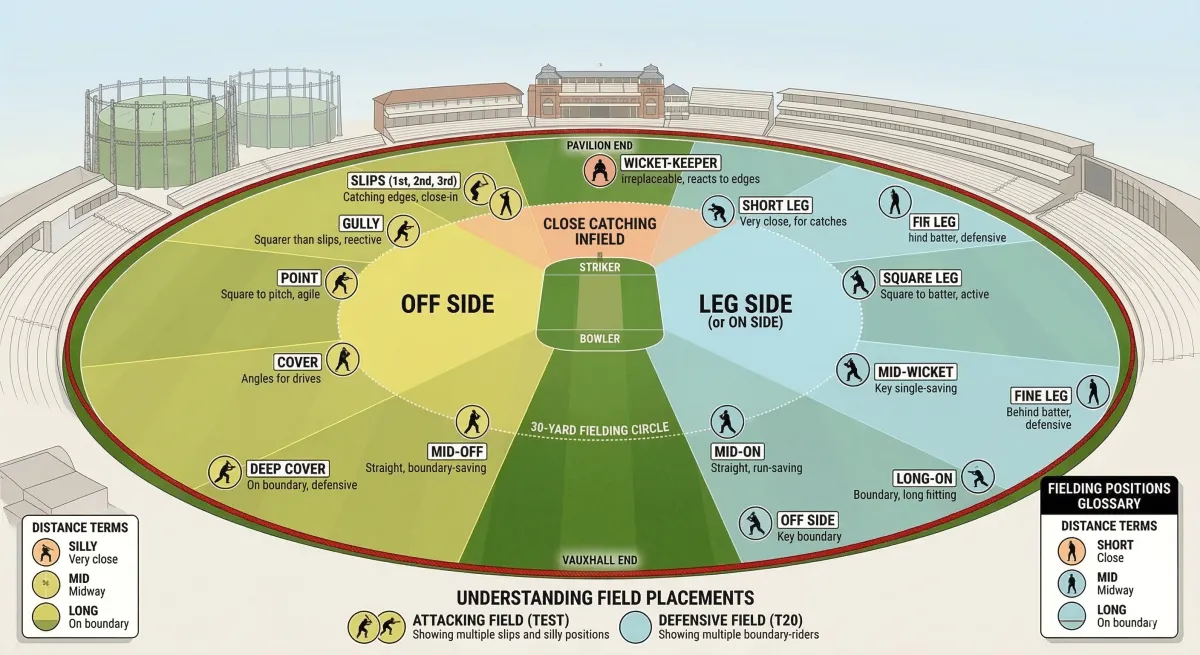
- The Off-Side: If the batter is right-handed, the entire half of the field to their right is the "off-side."
- The Leg-Side (or On-Side): The entire half of the field to their left (behind their legs) is the "leg-side."
- The Pitch: The 22-yard central strip where the main action happens.
- The 30-Yard Circle: An inner ring that dictates fielding restrictions, especially in limited-overs formats like One Day Internationals (ODIs) and T20s.
- The Boundary: The outer perimeter of the field.
The Wicket-keeper: The Anchor of the Innings
The only fielder allowed to wear gloves and external leg guards, the wicket-keeper is the heartbeat of the fielding side. Standing directly behind the stumps at the striker’s end, the keeper dictates the energy of the field.
For fast bowlers, the keeper stands several yards back to catch edges that fly off the bat at 140 km/h. When the slow, looping deliveries of a spinner come into play, the keeper crouches right up against the stumps, ready to whip off the bails for a lightning-fast stumping if the batter drags their foot outside the crease.
The Catching Cordon: Waiting for the Edge
When a fast bowler is operating with a brand-new, swinging ball, the primary goal isn't to restrict runs; it's to take wickets. This is where the catching cordon comes into play.
- First, Second, and Third Slip: Positioned strictly on the off-side, adjacent to the wicket-keeper. These fielders form a diagonal line, staggered so they don't dive into each other. They require razor-sharp reflexes, soft hands, and endless concentration. A dropped catch in the slips can change the course of a match.
- Gully: Standing slightly further forward and wider than the slip cordon, the gully fielder is there to catch balls that are sliced or hit heavily off the outside edge, popping up at awkward, fast angles.
The Inner Ring: The Off-Side Wall
As we move out to the edge of the pitch and the 30-yard circle, we meet the fielders tasked with stopping quick singles and putting pressure on the batter's primary scoring zones.
- Point: Located square on the off-side, roughly in line with the popping crease. This is often reserved for the most athletic, acrobatic fielder in the team. They deal with fierce square cuts and must be capable of diving full-stretch to save boundaries.
- Cover: Positioned forward of square on the off-side. The cover drive is one of the most beautiful and frequently played shots in cricket; the cover fielder is there to intercept it.
- Mid-Off: Standing straighter down the ground, closer to the bowler on the off-side. Their job is to cut off straight drives and hustle the batters trying to steal a quick run.
The Inner Ring: The Leg-Side Trap
The leg-side fielders need a mix of bravery and agility, as balls hit to this side are often struck with immense power.
- Square Leg: Positioned exactly 90 degrees to the batter on the leg-side. They are in the direct firing line for the pull shot and the sweep. Umpires also stand in this vicinity (at square leg) to judge run-outs and bouncers.
- Mid-Wicket: The leg-side equivalent of Cover. This is a very busy position, especially against spin bowlers, as batters frequently look to work the ball into the gaps in this area for ones and twos.
- Mid-On: The leg-side counterpart to Mid-Off. Along with Mid-Off, they form a tight V-shape around the bowler to protect the straight boundaries.
The "Silly" Positions: Bravery Unbound
If you hear a position with the word "Silly" or "Short" in it, it means the fielder is standing perilously close to the batter. These positions are primarily used in Test cricket, particularly when a spinner is utilizing a dusty, deteriorating pitch where the ball is turning sharply and bouncing unpredictably.
- Silly Point: Standing just a few feet away from the batter on the off-side.
- Short Leg: Standing just a few feet away on the leg-side, directly in the batter's peripheral vision.
Why are they called "silly"? Because historically, it was considered downright silly to stand that close to a swinging piece of willow without much protection. Today, these fielders wear helmets, shin guards, and chest pads, acting as a human net to catch the faintest of inside edges or balls that pop up off the batter's pads.
Patrolling the Outfield: The Boundary Riders
In the modern era of T20 leagues and massive bats, protecting the boundary ropes is more crucial than ever. Outfielders need to possess sprinter's speed, a cannon of a throwing arm, and the spatial awareness to pull off spectacular catches right on the edge of the rope.
- Third Man: Located on the boundary behind the batter on the off-side. They clean up edges that fly past the slips or intentional late-cuts.
- Fine Leg: Located on the boundary behind the batter on the leg-side. When a fast bowler strays onto the batter's pads, the ball is often flicked away rapidly toward fine leg.
- Deep Point & Deep Cover: Sweeping the off-side boundaries to protect against powerful square cuts and lofted cover drives.
- Long-Off & Long-On: Positioned on the boundary straight down the ground. In the final overs of a limited-overs match, these are the busiest fielders, as batters attempt to launch the ball over the bowler's head for six.
- Deep Mid-Wicket & Deep Square Leg: Guarding the leg-side boundaries against the mighty pull shots and massive slog-sweeps.
The Captain's Dilemma: Attacking vs. Defending
Understanding fielding positions is only half the battle; knowing when to use them is where the true art of cricket lies. A captain’s field placement dictates the narrative of the game.
The Attacking Field Usually seen in Test cricket or the opening overs of an ODI. The captain wants to take wickets. The field will feature three or four slips, a gully, and close-in catchers. The outfield is left relatively empty, inviting the batter to take risks and hit over the top. The mentality here is simple: we don't mind leaking a few boundaries if it buys us a wicket.
The Defending Field Predominantly used in T20 cricket or the dying stages of a tight chase. The captain pushes fielders out to the boundary—Long-On, Long-Off, Deep Mid-Wicket. The slips are removed, and the inner ring is tightened to stop easy singles. The goal is to choke the run rate, frustrating the batter into playing a false shot out of sheer desperation.
The Evolution of Fielding
The geometry of the cricket field hasn't changed in over a century, but the athleticism has evolved lightyears. Gone are the days when a team carried one or two sluggish fielders who were simply "hidden" down at Third Man.
Modern teams practice relay-throws, sliding boundary saves, and direct hits at a single stump. A diving stop at backward point that saves three runs is celebrated with the same vigor as a boundary hit. The fielders are no longer just reacting to the batter; they are proactively shrinking the field, making the 360-degree oval feel incredibly claustrophobic for the person holding the bat.
Summary
The next time you tune into a match, take your eyes off the ball for a moment. Watch how the field shifts when a new batter arrives. Notice how the point fielder creeps forward to pressure a timid player, or how the captain pushes a fielder back to the boundary just before the bowler delivers a disguised slower ball.
Cricket is a game played with bat and ball, but it is won and lost in the placement of the eleven players scattered across the green grass. Once you understand the map of the oval, you stop just watching cricket you begin to truly read the game.